ABOUT CAMARASAURUS. Camarasaurus (“chambered reptile”) was a large, plant-eating Sauropod that lived during the Late Jurassic Period. Remains of Camarasaurus have been found on the North American, African and European continents.
Adults grew to from 50-60 feet in length and had a stocky body shape. The legs of Camarasaurus were hefty, robust and powerful, and the neck and tail were shorter than those of its other Sauropod relatives.
In 2007, this amazing articulated, close to 90% complete skeleton of a Camarasaurus was discovered at the digsite. Found in the classic death pose, it's now in a museum in Japan.
Camarasaurus was a more robust "long-neck" dinosaur than Apatosaurus or Diplodocus, with a shorter but nonetheless powerful tail.
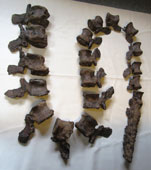
(Left) These articulated caudal or vertebrae come from an adult Camarasaurs. What you see are vertebrae from about midtail down to the very tip. Towards the distal/far end, the smallest vertebrae tend to fuse together during fossilization.
Spoon-shaped teeth. The large head of the Camarasaurus is characterized by a short, blunt snout. Numerous chambers in the skull, which continue in the vertebrae, made its skeletal structure lighter.
Camarasaurus’ 54-56 teeth have a spatulate shape. Many of the teeth we’ve found show a distinctive wear pattern that tells us that this dinosaur fed on coarser plant material.
Large foot bones. Each huge foot had five toes, with a large, sharpened claw on the “big toe” for self-defense.





.jpg "Camarasaurus discovery") ABOUT CAMARASAURUS. Camarasaurus (“chambered reptile”) was a large, plant-eating Sauropod that lived during the Late Jurassic Period. Remains of Camarasaurus have been found on the North American, African and European continents.
ABOUT CAMARASAURUS. Camarasaurus (“chambered reptile”) was a large, plant-eating Sauropod that lived during the Late Jurassic Period. Remains of Camarasaurus have been found on the North American, African and European continents.
.jpg "Camarasaurus tooth")
.jpg "Camarasaurus hindfoot bones and claws")


